
It’s much more about automation NOW. Businesses are indeed understanding how beneficial an AI workflow can be for them.
The user adaptability has been so high that even for complex workflows, you don’t have to be an expert at coding. Rather, a simple text that you write can be converted to workflows by the tools.
When teams rely on such automation, the efficiency is higher, tasks are optimized, teams are organized, no burden about routine work.
As per the Harvard Business Review report, 2/3rd of the organizations consider AI adoption a strategic priority.
What is AI Workflow?
AI workflow is utilizing the artificial intelligence to automate various tasks within a business.
What leaders like about AI workflow tools is that they adapt to the situation. They are flexible, unlike the rigid and pre-programmed rules that were once used to run these tools.
The human intervention is very little, so mistakes are unlikely to happen. It can handle more complex scenarios, understand every language, and predict outcomes.
Small businesses can easily scale up. It gives them a lot of opportunities to get better results with small teams.
Components of AI Workflow
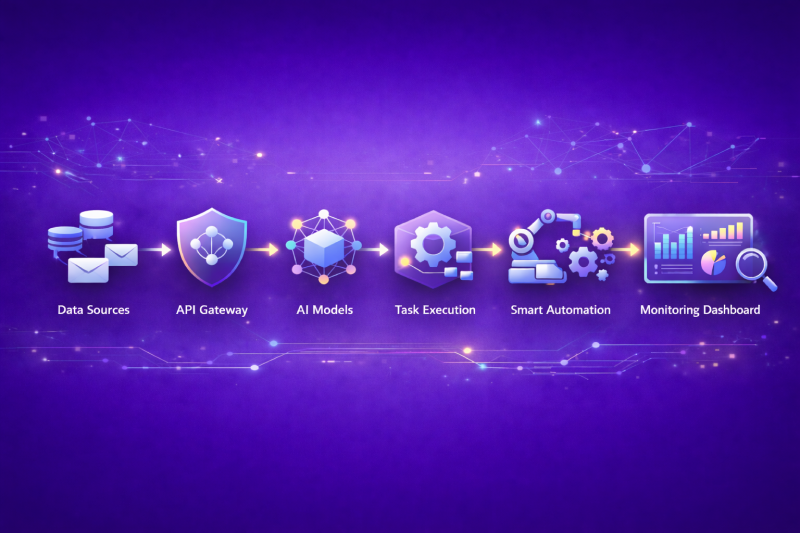
API Gateway
It is the main entry point for all requests in an AI driven CRM. It receives incoming calls from users or apps, then checks on security like authentication and rate limits. Then, routes them to the right services.
It also handles load balancing and transforms data formats if needed. Without it, the workflows get complex with direct access everywhere.
Benefits include faster responses and easier scaling as your AI system grows.
AI Algorithms and Machine Learning
Algorithms analyze processed data to identify patterns or predict outcomes. They use neural network or decision tree models for this.
In workflows, they handle tasks like image recognition or text analysis. It drives value, turning raw inputs into smart decisions that automate complex jobs efficiently.
Task Execution
An AI task manager does automation, managing and optimizing a series of steps such as data ingestion, processing, modelling, and then output.
It runs the actual jobs in an AI workflow once triggered. Each task is small and focused. It failed, it allows retries.
Parallel execution speeds things up for high-volume needs. It even monitors tracking status, errors and duration for debugging.
Smart Automation
It makes workflows smart and flexible. It learns along the way and improves itself.
Instead of fixed rules, it is flexible in its decisions. It spots problems early. Update leads or automate emails smarter.
The challenge is linking it to old systems, but APIs fix that easily.
Monitoring & Logging
It watches your AI workflow in real time. It tracks speed, errors, and computer use.
Alerts are sent for issues like when AI starts giving wrong answers. Dashboards let you see trends to make things better.
For business, the AI in sales catches sales prediction drops or even any glitches. The records can be used for analysis.
Benefits of AI Workflow in Your Business

1. Better customer experience
Each of the processes counts only when the customers buy from you. If there are no sales, the efforts are in vain. To increase the chances of closing the deals, you need to provide a great customer experience.
The brands should focus on the problems of customers rather than being generic. Your teams should be aware of what the customers actually want. The AI workflow gathers all the information and then uses it when contacting the customers.
This builds trust. Also, the user interface of the tools you use should be good.
2. Works Faster and Smarter
The repetitive jobs are automated with the help of AI. Teams can work 20-40% faster.
Manual work like data input, sorting potential customers, and sending email campaigns is done automatically.
For sales and online stores, this helps you handle lots of orders and new customers much quicker.
3. Saves You Money
AI cuts costs by 20-47% in just a few months. It reduces manual tasks and prevents mistakes that waste time and resources.
For marketing agencies and online shops, this means spending less on daily tasks and boosting sales more quickly. You keep more profit while achieving better results.
4. Makes Smarter Choices
AI analyzes your business data in real-time to spot patterns and trends. It helps you understand what your customers want and how they shop.
Instead of guessing, you get clear insights to guide your decisions. CRM tools use AI to give personalised suggestions. This cuts errors by up to 50% and boosts customer service.
5. Grows With Your Business
AI can handle increasing workloads as your business grows, without needing extra staff. When you get more customers or orders, AI adjusts itself.
This keeps everything running smoothly. This helps your CRM systems and sales processes grow smoothly as your business becomes more successful.
AI workflow use cases
Marketing agencies
Marketing agencies have to check on various processes at once. If each process is connected and they see reports on one customized dashboard, it becomes much easier for them to work and manage everything.
Every campaign is personalized, and scaling operations becomes efficient. Audience segmentation is automated, and budget allocation and lead scoring across emails and ads become easy.
Data are drawn into dashboards from ads, social media, and other systems with automated reporting that shows ROI. So you can strategize accordingly.
Ecommerce Personalization
Autonomous AI agents help online stores understand what customers like to buy. When they are shopping online, Ai keeps a watch out on their cart.
It suggests products that the customers might like and even offer special prices that are customized for them. This increases the chances of sales.
Big stores like Amazon use this tech to sell more stuff. If the customers leave items in their cart without buying it, then the AI will send personal discounts through chat messages.
Real Estate Valuation
Real estate agents go through a lot. Getting in touch with the clients, explaining each property to them, scheduling meeting for giving a tour, and more.
All these manual tasks are automated using an AI workflow. The AI will even scout thousands of homes for sale, check their prices in the neighbourhood, and even study photos of properties.
This helps the agents expand more, and show the right properties to customers as per their budgets.
CRM Lead Scoring
AI helps a lot in sales. It finds the best customers for your business. It looks at information about potential buyers and then figures out who will buy the earliest.
Personalization is the key factor here. The AI will go through the customer profile, then create personalized content that is solely for that particular customer which he/she will resonate with.
This makes the customers feel valued, and they tend to buy from your brand. Sales team that use such a system see 30% faster sales process.
AI workflow automation tools
1. Centripe
Centripe helps you create an ai workflow that is powerful. From generating leads, then feeding them content to nurture it, doing the actual sales and customer experience.
It brings email, chat, phone calls, and customer tracking into one customized dashboard. So, businesses can talk to customers and keep track of everything.
It uses chatbots and voice AI agents that understand customers. You can create workflows using simple language; no coding is required.
2. N8n
n8n helps you connect different apps and build automated workflows without writing code.
You can host this on your own computer, keeping the business data safe and private. Add more AI features to make smart workflows.
With a simple drag and drop system with visual blocks called notes, you can connect everything. These nodes can handle AI tasks like pulling information from documents.
This tool works best for people who like technology and want complete control over their automated workflows.
3. Zapier
One of the best apps to automate sales workflow. It works by creating zaps, which are simple automated tasks that start when something happens in one app and then do something in another app.
It lets you build a multi-step ai workflow with branching paths, which means automation can make different choices based on what happens.
It is perfect for quick projects in online stores or marketing because it doesn’t require a complicated setup.
4. ActiveCampaign
A smart marketing automation that uses AI to help businesses manage their sales and customer relationships.
A visual builder lets you create automated ai workflows based on how customers behave, like opening emails or visiting your website.
It combines customer tracking, email marketing, and sales management in one place. The AI campaign builder writes customized emails for you and recommends the best times to send them.
How to implement these tools for AI workflow?
1. High-Value Use Cases
Focus on workflows like lead scoring or customer follow-ups. AI can provide quick time and cost savings here. In e-commerce and agencies, focus on repetitive, high-volume tasks. For example, handle sentiment analysis from chats first. This aligns with real-world CRM implementations like Centripe.
2. Data Readiness
Make sure to have clean, structured data from CRM sources before deployment. This will help provide accurate AI predictions. Audit and standardize inputs like lead histories to prevent errors in automation flows. For sales tools, integrate with existing databases early for reliable scoring.
3. Compliance Focus
Embed audit trails and logging from the start to meet regulations in sales or e-commerce. Use transparent AI decisions to track actions, essential for agency white-label setups. This builds trust while handling sensitive customer data securely.
4. Scalable Design
Select platforms that expand with team growth and task volume. Build modular workflows for easy additions. Plan for API gateways to handle increasing loads without rework.
5. Ongoing Optimization
Set up monitoring dashboards for metrics like conversion rates and retrain models iteratively. Gather team feedback loops to refine processes based on practical results. This sustains gains in dynamic sales environments.
No Spam. No calls. Unsubscribe anytime.
Conclusion
Businesses that are adopting such high-tech systems are already winning. AI in CX, AI in marketing, and AI in sales have all become a necessity.
The tools aren’t just an assistant now, they are full time working employee. A bit of investment in such tools will surely bring bigger results than expected.
With AI workflow doing the work, teams can work on strategies, think about critical points, like how to increase customer base, how to be creative for campaigns, how to connect with the audience, and more.
The sooner you adopt such systems, the better it is for your business. This helps in every process, including making your team up-skill themselves. Which in turn is beneficial for your brand.
Frequently Asked Questions
