Omni Channel Communication is a system where customers receive the same personalized response or interaction from the teams, irrespective of the platforms they are using.
What frustrates customers is co mmunicating with one brand on different platforms, and still have to explain their issues repeatedly, brands delivering varying tones, promotions, or information across channels, customers are unable to switch between channels, getting a generic response.
I don’t think anyone would like that. Communication should be smooth, and every sentence should be progressive.
Even if the customers have opted-in, the brands might cause spamming risks by messaging across many channels.
When there are multiple channels involved, it’s hard for customers to track business messages.Single-channel is better for effective customer interaction.
What is Omni Channel Communication?
Omni Channel Communication is providing a unified customer experience and building a brand reputation.
For example, a customer sent an SMS, then along the conversation, he moved to WhatsApp, and then completed the product purchasing on email, the communication should be easy going and smooth.
Here’s the clear difference:
Single channel communication: Only one platform is used for communication. ( Bad impression, because the customers are bound )
Multi channel communication: Many platforms are used. ( The problem is customer journey isn’t integrated, which makes the customer feel as if they are talking to different executives. )
Omni Channel Communication: All the platforms are connected. ( The customers feel valued, they can move seamlessly from one platform to another, and the conversation continues from where it was stopped.)
How Does Omni-Channel Communications Work?
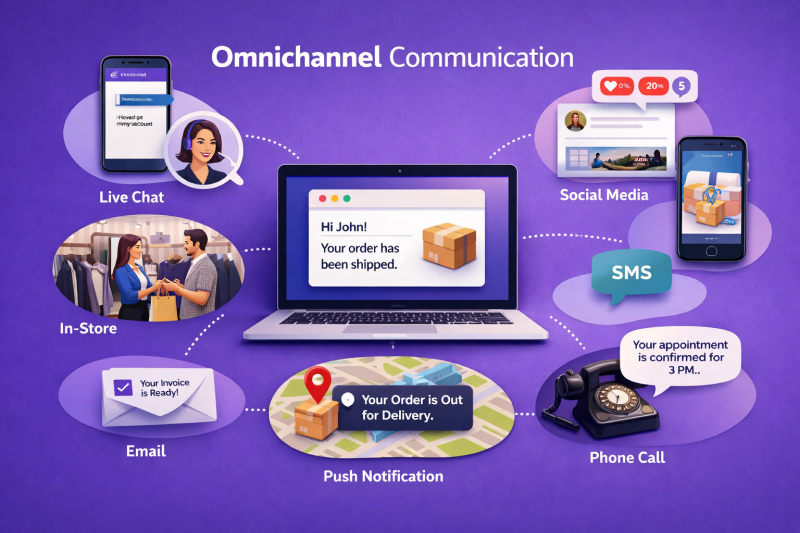
It brings together email, SMS, social media, chat, phone, and in-store interactions into a single system. This creates a better experience for customers.
It uses a central data system and an omni channel customer communications platform to sync interactions. This ensures that context is maintained, even when switching channels.
Brands collect the customer preferences and then use data analytics to personalize messaging and timing.
A central hub routes the communications, powered by AI for responses. It uses chatbots, voice agents, and automation, while maintaining consistent branding.
For example, a customer who sends a query via app chat can seamlessly continue via phone without repeating any details.
So summing it up, it unifies data, interacts across any platform from one screen, and using data analytics for insights to personalize the communication and make the customers feel valued.
What Are the Key Benefits of Omni Channel Communication for Customer Experience?
Enhanced Customer Experience
It ensures that every interactions are smooth and consistent across email, chat, social media, and others.
Every touch point feels easy and helpful. Customers can easily switch channels without losing conversation history, which increases satisfaction.
This approach builds trust, turning regular interactions into great experiences that focus on convenience and usefulness.
Companies with strong omnichannel strategies keep up to 89% of customers, compared to 33% for weak ones.
Personalization and Customer Retention
When the messages are personalized, the customers feel happy. They will remember your brand and buy from you again.
This is done using the customer data to deliver helpful offers and support at the right time.
Brands that use omnichannel customer support retain around 80% of their customers.
Because it strengthens relationships, encouraging customers to come back.
Higher Engagement Leading to More Conversions
When the engagement level is high, definitely the conversions will increase.
When customers get easy access to their favourite channels, it keeps them actively involved from browsing to buying, with timely reminders and simple transitions.
Higher engagement brings in more sales as personalized prompts and being available everywhere reduces abandoned carts, speeds up decisions, and purchases.
Omnichannel marketing automation
When businesses get every detail about the customers, their demographics, and behavior, they can use it to customize the ads and marketing posts.
This will resonate with the customers, and they are more likely to buy from the brand.
Targets are set, needs are predicted, and campaigns are optimized, which drives smart decisions and gives an advantage compared to the competitors.
Companies with strong Omnichannel strategies gain deeper behavioral insights, with 87% outperforming competitors.
Why Is Omni-Channel Communication Important for Modern Businesses?
For modern businesses, it is not just about showing products to their customers. It’s about how good the service they are providing is.
The AI powered tools have become so powerful that they collect data from every source, create a customer profile, give you an overview of what are the pain points of these customers, and then you can prepare the strategy accordingly.
WIth omni channel communication, shopping online, calling support, and getting quick answers without repeating themselves becomes easy.
Customers can switch between apps, emails, texts, social media, websites, and stores.
They expect that the brands can keep up easily. Omnichannel connects all the platforms to a single customer view. This reduces frustration and builds trust.
Businesses see up to 30% higher sales from loyal customers. It personalizes chats and speeds up solutions.
It collects information to predict needs, like suggesting sizes based on past purchases.
For marketing agencies, this is crucial. As marketing depends on the level of personalization.
From social media to email, customers want what’s better for them. And if brands send them generic things, they will ignore or put it in spam.
What Is the Difference Between Multi-Channel and Omni-Channel Communication?
Omnichannel vs Multichannel:
| Aspect | Multi-Channel | Omni-Channel |
|---|---|---|
| Integration | Channels operate independently | Channels are seamlessly connected |
| Focus | Brand reach via separate channel | Customer-centric unified experience |
| Messaging | Varies by channel | Consistent across all touchpoints |
| Experience | Fragmented for users | Personalized and fluid |
Multi-channel doesn’t share the information. That’s the main issue. If a customer is interacting with the brand at WhatsApp, and he has already explained what he wants.
Now, if he moves to another platform, the information has to be repeated. This is irritating for customers.
Omni-channel is advantageous!
It shares the information, so that the customers are kept at a high priority.
Multi-channel gives choices but keeps data apart. Agents only view channel-specific history, so repeats occur.
Numbers stay separate, setup is quick but disconnected. Omni-channel connects everything via CRM for easy transitions.
How Can Businesses Successfully Implement an Omni-Channel communications Strategy?
To set up omni-channel, first discuss with your teams.
Check how many channels you are active on. Then choose an omnichannel platform like Centripe to combine the data.
Steps:
- Use AI to build customer profiles with preferences.
- Connect the tools, like API for SMS, email, chat, etc.
- Give training to staffs on shared dashboards.
- Use AI chatbots to communicate with customers.
- Study the response times and satisfaction level.
No Spam. No calls. Unsubscribe anytime.
Conclusion
Omni-channel communication turns messed-up customer chats into smooth journeys.
Data isn’t scared anymore. Personalized chats convert more customers, which increases sales numbers.
Brands have ample opportunities to expand their business, as they gain valuable insights.
Conversations are important from the point of view of marketing and sales. When the systems are simplified, it paves the way for right on point strategies.
Hence, having an omni channel communication becomes mandatory for brands that want to build a reputation.
Frequently Asked Questions