
Brands are using Autonomous AI agents to build a wider customer base and increase ROI. This has been proving to be a very effective strategy for them.
It benefits every department, be it sales, marketing, or customer service.
The question isn’t about implementing, it’s about scaling up using AI in business. Teams stay informed with accurate data, sales reps have all the information to create a pitch that turns leads into customers.
In this article, you will understand what these AI agents are, how they work, and what the benefits are for businesses, among other things.
What Are Autonomous AI Agents?
Unlike the traditional agents, these autonomous ai agents are very smart and take instant decisions based on their thinking.
So, it’s not like they are working on pre-defined rules, rather the AI in sales take customer data, interact with them, and act as a sales/ customer agents, depending on the situation.
They can make decisions by themselves. Look at a situation and figure out the best way to handle it.
These AI agents are advanced and do the basic things along, like answering the queries promptly, solve minor issues, and guiding them.
Autonomous intelligent agents plan ahead, use different tools and fix mistakes on their own. The clear difference between the regular automation and the autonomous agent is the kind of tasks they do.
How Do Autonomous AI Agents Work?
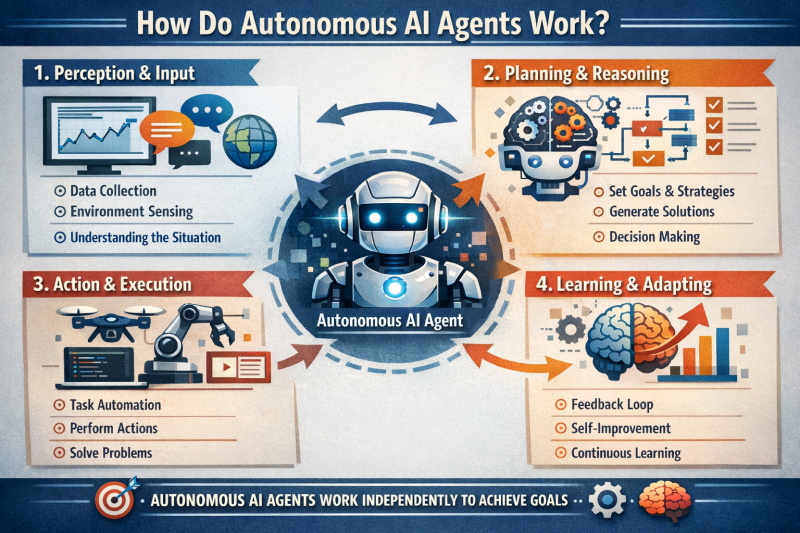
At first, they collect information and think about what to do next. Then take action to complete the task. Now, they check the results to see if it worked. If it doesn’t, they try a different approach.
AI in business intelligence uses LLMs as its brand. It helps them read, understand language and think through the complex problems step by step.
They get access to different tools they can use. Each job is done with perfection.
Memory is a key part of how they work. Autonomous AI agents remember what they have tried before and what worked or failed.
So, unlike human agents, they don’t make the same mistake twice. What teams can do is train them accordingly. Give feedback so they get better over time.
It can handle multiple tasks at once. And do each of them perfectly.
Key Features of Autonomous AI Agents
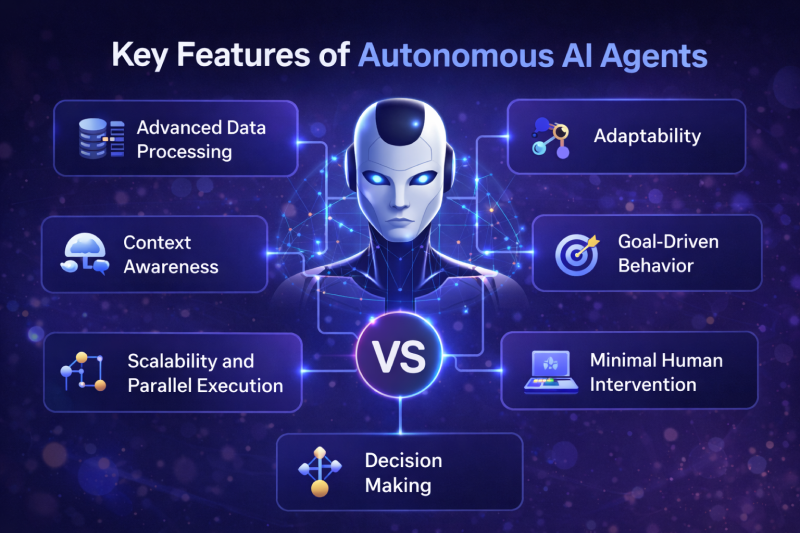
1. Advanced Data Processing
Give them huge amounts of information, and they will process it very fast. They read through documents, numbers, and data that would take humans days to finish.
They spot patterns and connect that people might miss. The agent organizes messy data into clear information for teams to use.
Text, numbers, images, give them any data, and they will present it in a simple manner so everyone understands it.
2. Adaptability
The concern for the utilization of AI in enterprise is the adaptability. But that’s actually a core strength of autonomous AI agents.
They change how they work based on new situations. If something unexpected happens, they don’t just stop or break down. Instead, they will adjust their approach to handle the new challenge.
These agents learn what works in different scenarios. When the situation changes, they adapt new methods. They bring results using the flexibility.
3. Goal-Driven Behavior
The focus is on reaching a specific end result. You give them a goal, and they figure out all the steps needed to complete the task.
They don’t just do random tasks or wait for instructions; instead, they work backward from the goal to create a plan.
The agent keeps the main objective as a priority while handling smaller tasks.
4. Minimal Human Intervention
This is something I like about autonomous AI agents. Teams don’t need to watch it constantly or give step-by-step directions.
The agent handles problems as they come up without calling for help. You just need to check in occasionally or when something unusual happens.
You set the goals and boundaries and then let the agent execute everything.
5. Scalability and Parallel Execution
Once your business gets bigger, these agents can grow to handle more work without breaking down.
One agent can manage multiple tasks, or you can run a hundred agents at once. The agents always scale up to match the business size.
Unlike humans, they don’t get tired of too much work. Each agent keeps performing well even when you add more to the system.
6. Decision Making
These agents can make choices on their own without any human intervention. They look at the problem and find the best solution, and execute it.
From a set of different options, agents choose what makes the best sense. They don’t follow a fixed script.
7. Context Awareness
The context is important. AI agents know the history of what happened before and what might come next.
They remember previous conversations and decisions related to the current work. The agent considers who they are working with and adjusts their communication style.
This awareness helps them make smarter choices that fit the actual situation.
Types of Autonomous AI Agents
Model-Based Agents
This one creates a picture of the world inside their system. It builds an internal model that shows how things work and connect to each other.
They think and predict what might happen next based on their internal understanding.
This predictive decision-making helps them plan better moves. The agents understand cause and effect relationship deeply.
The model gets updated constantly as new information comes in.
Example: DataDog uses model-based agents to predict server crashes by modeling normal infrastructure behavior and alerting IT teams before failures occur.
Utility-Based Agents
These agents make the best possible choice. Different options are analyze before reaching to a decision.
These agents excel at optimization problems where you need to balance multiple factors.
They are great at making trade-off decisions when you cannot have everything perfect. Every possible action is assigned a utility value.
Higher numbers mean better outcomes for your goals. For example, you want high conversion rates, but also need to control the advertising costs, then the agent finds the best opportunity automatically.
These systems handle multi-objective optimization naturally. Maybe you need fast service, low costs, and high quality all at once.
Example: AWS Auto Scaling uses utility-based agents to balance application performance against cloud costs by automatically adding or removing servers based on traffic.
Multi-Agent Systems
Many agents work together on complex tasks. Instead of one agent doing everything, multiple agents collaborate and coordinate their efforts.
Agents share information and help each other. One agent might gather data while another analyse and the third takes action.
The system also prevents agents from working against each other or duplicating efforts.
Communication protocols help agents share updates efficiently. They send messages about what they’re doing and what they’ve learned.
AI in CX benefits greatly from multi-agent systems because customer service requires different skills. One agent handles greetings, another solves technical problems, and another processes refunds.
Example: ServiceNow uses multi-agent systems where different specialized agents handle password resets, software installations, and network issues simultaneously while coordinating their actions.
Learning Agents
Learning agents improve themselves through experience over time. They start with basic abilities and get smarter as they work.
Every task teaches them something new that makes them better at future tasks.
Reinforcement learning agents learn through trial and error, just like humans do. They receive rewards for good actions and penalties for bad ones.
The learning process never stops. Even after months of operation, these agents continue finding small improvements.
These agents need feedback to learn effectively. This feedback loop drives the improvement process. More feedback means faster learning and better performance.
Example: GitHub Copilot uses learning agents that improve code suggestions over time by learning from millions of developer interactions and which recommendations get accepted or rejected.
How Autonomous AI Agents Can Help Your Teams
Sales & Customer Support
Sales teams get automatic lead scoring that identifies ready to buy prospects instantly.
You can analyze customer behavior, past interactions and engagement patterns to prioritize the pipeline.
Agents draft personalized outreach messages and schedule follow-ups at optimal times.
For support teams, agents handle common questions about passwords, shipping, and basic troubleshooting automatically.
Marketing & Growth
If you ever come across a question What is AI marketing and how these agents make it effective.
Well, Marketing agents personalize campaigns for thousands of customers simultaneously.
Autonomous AI agents test headlines, images, and messaging. They analyze data across all platforms to show which campaigns drive revenue.
Content creation accelerates as agents draft social posts and emails matching your brand voice.
Ad spending gets optimized in real-time across channels based on performance.
Operations & Supply Chain
Agents monitor inventory levels and predict shortages before they happen.
They reorder supplies without prompting and optimise shipping routes to reduce costs.
Warehouse operations improve when agents coordinate schedules, track shipments, and quickly flag delays.
Engineering & IT
Development teams gain a lot from agents that automatically check code. They find bugs and spot security issues, too.
System monitoring happens continuously, with agents detecting performance issues before users notice problems. Deployment processes become faster and safer.
Leadership & Decision Intelligence
Executives get clear insights when agents look at market trends, competitor actions, and internal performance data.
Using artificial intelligence in business helps leaders discover hidden chances and risks in complex data.
Strategic planning becomes data-driven with agents providing accurate forecasts and scenario modeling.
Best Practices to Implement Autonomous AI Agents in Your Business
1. Start with Low-Risk Workflows
Begin with simple tasks where mistakes won’t cause big problems. Try the agent on internal processes first before putting it in front of customers.
This helps your team learn how agents work without risking important business operations.
2. Define Clear Goals & Guardrails
Tell the agent exactly what you want it to do. Set clear boundaries that it cannot cross. Be specific about what success looks like.
Vague instructions lead to confusing results. Write down the rules the agent must always follow.
3. Human-in-the-Loop Design
Always keep people involved in important decisions. The agent should help and suggest ideas, but humans make the final call.
This prevents costly mistakes and keeps your business running smoothly. Review the agent’s work regularly to catch any issues early.
4. Security, Compliance & Data Privacy
Protect your customer information carefully. Make sure agents follow all privacy laws and regulations.
One data leak can destroy years of customer trust. Set up strong security measures from day one.
5. Measuring ROI and Performance
Track how much time and money the agent saves. Count the errors it prevents and the extra revenue it generates.
Use real numbers to prove the agent delivers value. If results aren’t good, figure out why and make changes quickly.
Case study: Autohive AWS AI Agent (Source- Amazon)
Autohive tackled slow AI adoption by building a no-code platform on AWS for autonomous AI agents.
Non-technical teams created agents via prompts, integrating Slack/Gmail for support, marketing, and analytics workflows, without coding.
Challenge: Technical barriers limited agent deployment to developers, causing siloed experiments.
Solution: Users define agent “teams” with tools; AWS Lambda/Auto Scaling handles billions of API calls securely.
Results:
- 40-60% faster automation
- Weeks-to-minutes development
- Enterprise security scaled adoption
No Spam. No calls. Unsubscribe anytime.
Conclusion
The autonomous AI agents are changing the dynamics of business operations across every department.
Businesses that deal with high volumes of customer interactions—such as sales-driven organizations, customer support teams, SaaS companies, and growing enterprises—should adopt autonomous AI agents first.
The biggest mistakes include deploying agents without clear goals, skipping human oversight, and ignoring data security and compliance. Treating autonomous agents as “set and forget” tools can lead to errors.
In 2026, autonomous AI agents will become more collaborative, more context-aware, and deeply embedded into CRM platforms.
Frequently Asked Questions