
You’ve got a product. You’ve got a website. But somehow, people visit and leave without buying anything.
That’s not a product problem. That’s a funnel problem.
A sales funnel is the path a stranger takes to become your paying customer. When it’s set up right, it feels natural to the buyer. They don’t even notice they’re being “funneled” anywhere. They just feel informed, comfortable, and ready to buy.
This is why understanding the stages of the sales funnel matters so much.
Why Your Sales Funnel Actually Matters
Before we get into the stages in sales funnel, here’s why you should care.
A. You must align your message with the location of the buyer.
A person who has never heard of your product will require a different message than someone who has already made three comparisons between you and your competitors. This difference becomes very clear when you understand the funnel stages in sales.
Say you sell home gym equipment. A person who just started their fitness journey needs to see “how to set up a home gym on a budget.” But a person who’s already shortlisted products needs a side-by-side comparison showing why yours is better.
The niche has the same message but with a completely different message. The funnel helps you determine which one to dispatch.
B. You can predict where you’re losing people
A funnel gives you data across the stages of sales funnel. You’ll know if 500 people visit your product page, but only 10 buy. That gap tells you something. Maybe your pricing page is confusing. Maybe there’s no social proof. Now you have a place to fix.
C. You stop wasting time on the wrong leads
Not everyone who lands on your site is ready to buy. This is especially true in b2b sales funnel stages, where buying decisions take time. A sales funnel helps you filter. The people who download your guide, sign up for your email list, or book a demo call are the ones worth your energy.
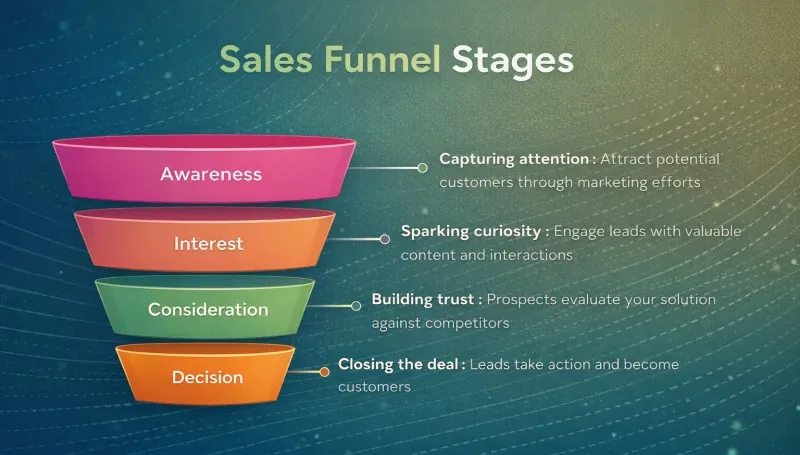
The 5 Stages of a Sales Funnel
These sales funnel stages explained below apply to most businesses, including saas sales funnel stages and digital sales funnel stages.
Stage 1: Awareness
This is where someone first finds out you exist.
They weren’t looking for you specifically. Maybe they saw a reel on Instagram. Maybe they googled a question and landed on your blog. Maybe a friend mentioned your name. That first moment of contact is the awareness stage.
Your job here isn’t to sell anything. It’s just to make a good impression and stay in their memory.
A practical example: imagine you run a small bakery that ships custom cakes. Someone scrolls past your “office cake fails vs. our cakes” video on TikTok and laughs. They don’t buy anything. But they follow you. That’s awareness working.
What works best in this stage:
Write blogs that answer real questions people are searching for. Post content on platforms where your audience actually hangs out. Run paid ads if you have the budget. The goal is simple: get seen by the right people.
Stage 2: Interest
Now they know you exist. They’re curious. They are still just window- shopping, though.
At this point, a person may visit your site, read some of your blog, or look at one or two of your video clips on YouTube. They have not dedicated themselves to anything. They’re just learning. This stage is critical across all stages of sales funnel.
Going back to the example of the bakery: the same individual that liked your TikTok content is clicking your bio link now. They scroll through your Instagram. They watch your process videos, your packaging and customer response. He or she is interested and has not taken any action yet.
How to keep them engaged:
Provide them with motivation to stick around. A complimentary guide, a useful newsletter, and behind-the-scenes content. Study more easily and without any pressure.
In case you are able to get their email here, then great. That is to say that you are able to continue communicating with them even after they leave your site.
The content on this level must be educative rather than selling. Think “how we handcraft each cake layer by layer,” not “buy our cakes today.”
Stage 3: Decision
Something shifted. They would no longer say this is interesting, but rather, I would like to have this.
This is one of the most important stages of a sales funnel, especially in saas sales funnel stages where trust plays a huge role.
Maybe they saw a testimonial that hit close to home. Maybe they compared you to other options, and you came out on top. Perhaps the issue you resolved before was now sufficiently serious to make them take action.
At the bakery: the person’s boss’s birthday is coming up. They remember the cakes they saw. They check your site again, read the reviews, and look at past orders. They’re leaning toward ordering, but haven’t pulled the trigger.
How trust is built here:
To a large extent, the work is done by reviews and testimonials. Real photos from real customers cannot compete with real pictures of real customers all the time.
Case studies help too. The fact that someone who ordered our assorted box as a team-building event in their quarterly meeting and re-ordered the following month is more compelling than our cakes being great.
Something minor can also serve to gain the trust, such as a sample, a free consultation, or a money-back guarantee. Reduce the risk of saying yes.
In the bakery, the boss of the person is going to celebrate his birthday. They recall the cakes they had witnessed. They visit your site once more, see the reviews, and look at the previous orders. They are bending towards placing an order, but have not drawn the trigger.
Stage 4: Action
They’re ready. They just need to actually do it.
This stage is where many digital sales funnel stages break down. The customer wants to buy, but something gets in the way. A clunky checkout process. Too many steps. Shipping costs that show up at the last second. No clear return policy.
At the bakery: the person puts a cake in their cart. Then they see you only accept bank transfers and the shipping cost was listed as “calculated at checkout.” They close the tab.
How to remove buying friction:
Make buying stupidly easy. Clear pricing upfront. Multiple payment options. A checkout that works on mobile. A visible return or refund policy.
Urgency works here too. “Order by Wednesday for Friday delivery,” or “Only 3 slots left this week.” These aren’t tricks. They’re just honest reminders that your capacity is real.
Follow up on abandoned carts with a simple email. Sometimes people get distracted and genuinely just need a nudge.
Stage 5: Loyalty and Re-Engagement
They bought. Now what?
This final step completes the stages of the sales funnel. Most businesses treat the sale as the finish line. It’s not. A customer who buys once and has a great experience is worth ten times more than a one-time buyer. They come back. They refer friends. They leave reviews.
At the bakery, the person gets their cake. It arrives beautifully packed, tastes amazing, and you sent a little handwritten note. They post about it on LinkedIn. Three of their coworkers ask where they got it.
That’s the funnel paying dividends without you doing anything extra.
How to turn a buyer into fans:
Even a thank-you email will help. Ask for a review a week after delivery. Provide a discount on their repeat order. Develop a referral system by which they receive gifts when they refer friends.
Keep them in their inbox with something that is not merely a promotional outburst. Being the first person they will think of is what you desire when their next occasion arises.
No Spam. No calls. Unsubscribe anytime.
Conclusion
A sales funnel doesn’t have to be complicated. It just has to match how real people actually make decisions across all stages in sales funnel.
They hear about you. They get curious. They want what you have. They buy. They come back.
Your job is to make each step feel easy and natural. When you do that, you don’t have to “convince” anyone of anything. They convince themselves.
Start by figuring out where you’re losing people in your current process. That’s your biggest opportunity right now.
