
Quick Answer: Simvoly is best for non-technical users, small businesses, and agencies that want to resell a branded builder. For agencies, Simvoly can be used to launch a white-label SaaS platform under your own brand, domain, and pricing. Reviewers have found mobile adjustments, custom code, and deeper customization less flexible than WordPress. So, it’s a builder combined with light CRM, not a full agency operating system. This Simvoly review looks at its features, pricing, white-label options, and overall fit for agencies.
What Simvoly Is
Simvoly is a website, funnel, and community builder aimed at non-technical users, small businesses, and agencies. It offers a drag-and-drop builder, ready-made templates, real-time editing and SEO management.
Unlimited funnels are available on higher plans, along with A/B testing, bump offers, upsells, downsells, and funnel analytics. It also includes a built-in CRM and email marketing with limited subscribers and monthly email sends on the base plans, with higher limits available on paid plans.
On ecommerce, Simvoly covers the basics: a full storefront, funnel checkouts, and product management, so you can sell without a separate platform. Appointments are handled in-platform too, with booking and scheduling built in.
Communities and courses are covered as well, including hosted videos, though reviewers have flagged limits around uploading course material and the membership experience, so test that against your own use case.
The white label is the piece agencies care about most. The platform can run 100% under your own brand, domain, pricing, and templates, with your own affiliate program on top, which is what turns Simvoly from a tool you use into a product you sell.
Features That Matter to Agencies
Building client sites
To build client sites, it has free SSL, and hosting is also included. Unlimited pages apply to every plan that you buy. The limit is on the websites, not on the pages. One site on Starter, Business, and Premium, and 5 on the Elite plan. AI assistant takes care of copy and SEO titles and descriptions.
Launching funnels
Starter plan does not have any funnels. In the Business plan, you get 5, and on the Premium plan you get 10, and the Elite plan has unlimited funnels. So, do check this against your client volume before committing.
Managing leads
You can use quizzes and surveys to collect scores, tag the leads, and skip any unnecessary steps. All lead information goes directly into the CRM, without the need for any separate tools.
Running campaigns
To run campaigns, you get SMS, WhatsApp, and voice messages in the same toolset as email. Subscriber volume is a paid add-on, from $9/month for 500 subscribers up to $1,499/month for 500,000, and each subscriber allows 12 emails per month.
Reselling a branded platform
This feature is what agencies like the most. They can set their own pricing plans, connect the payment processor, and bill customers directly. In this Simvoly white label review, the key point is that agencies can brand, price, and resell the platform under their own name.
Using the platform skin, they can restyle the builder, while the affiliate program is a WL Advanced and Ultimate feature, not included in the basic plan.
Client organization
Each client get their own project with a separate domain, statistics, and admins. Each project costs $8, $7, or $5 per month; that depends on the white-label plan. The total cost increases as you add more clients.
Enablement
Four training academies cover Websites, Funnels, Marketing, and Community. With WL Advanced and higher plans, you can offer these courses to clients under your own brand.
Recurring services beyond sites
Appointments, communities, video hosting with analytics, and ecommerce with 0% transaction fees give you more than site builds to sell on retainer.
Pricing and Plan Structure
Simvoly pricing varies by plan, with separate pricing for standard websites, funnels and white-label features.
Websites and funnels (vendor page)
| Plan | Monthly | Annual (per mo) | Websites | Funnels | Traffic |
|---|---|---|---|---|---|
| Starter | $18 | $12 | 1 | none | 20GB |
| Business | $36 | $29 | 1 | 5 | 60GB |
| Premium | $49 | $39 | 1 | 10 | 100GB |
| Elite | $97 | $79 | 5 | Unlimited | 200GB |
White label
| Tier | Monthly | Annual (per mo) | Included project | Extra project from |
|---|---|---|---|---|
| WL Basic | $69 | $59 | 2 sites, 10 funnels | $8/mo |
| WL Advanced | $149 | $129 | 5 sites, unlimited funnels | $7/mo |
| WL Ultimate | $497 | $429 | Unlimited sites and funnels | $5/mo |
Review Evidence
What Real Users Say
This review draws on user feedback from Capterra (72 reviews, 4.8), G2 (18 reviews, 4.4) and Trustpilot (12 reviews, 4.3), plus Findstack, which aggregates largely from G2. Volume is low against the thousands Wix and WordPress carry, so treat the averages as indicative rather than conclusive.
What Users Like: Pros
These Simvoly pros and cons become clearer when you compare its easy setup and broad features with its limits on customization and advanced functionality.
Support:
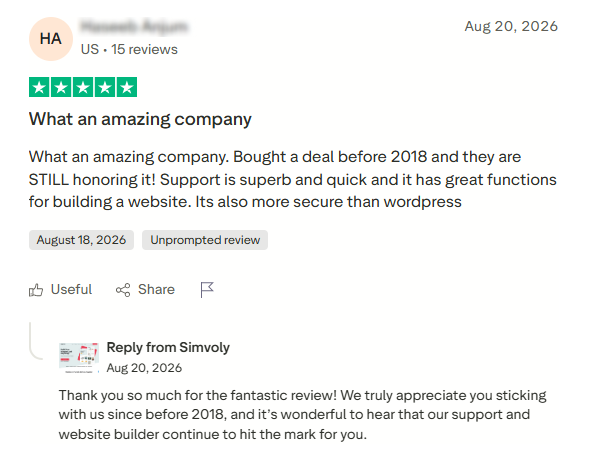
It is the most common positive feedback across every platform. Reviewers have said that the support responds within minutes and helps them set up email automations easily. This is useful for agencies that don’t have an in-house technical team. This maps to the live chat support included on every plan and the automation flows in Simvoly’s marketing toolset.
Have a look at this: Source: trustpilot
Speed to launch:
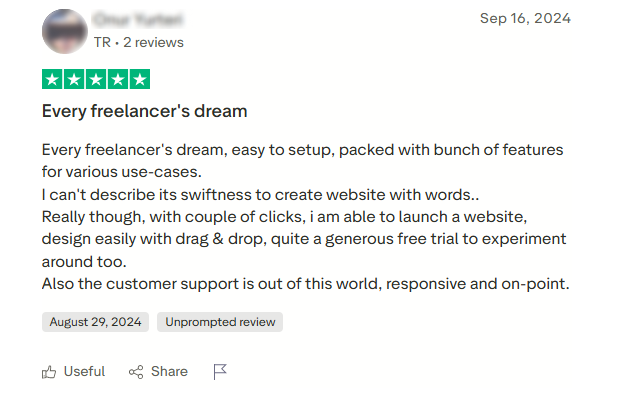
Users who don’t have any technical experience have said that they can build websites, funnels, and stores in days instead of weeks, using the drag-and-drop editor and ready-made templates. The AI Assistant also generates copy, SEO titles, and descriptions.
Value:
Simovly offers similar results to larger US funnel builder software at a much lower price. Plans start at $12 per month billed annually, with hosting and SSL included and 0% transaction fees on ecommerce.
Breadth in one place:
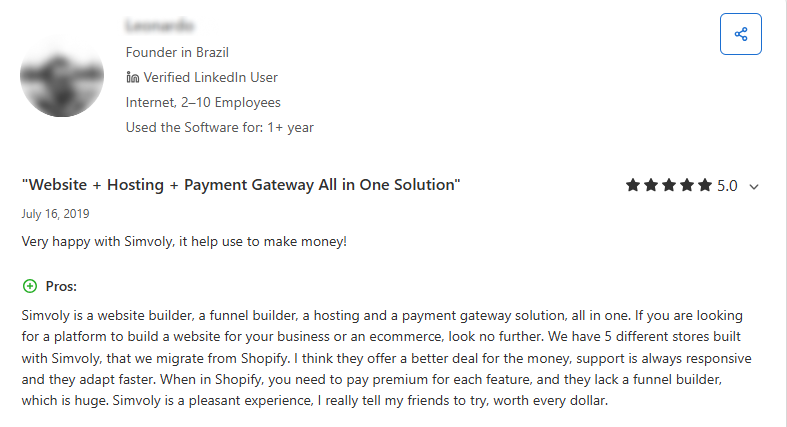
You get websites, funnels, forms, email, and memberships in one place under one login. Several reviewers have said that they replaced two or more subscriptions with Simvoly. The built-in CRM, quizzes and surveys, video hosting, appointments, and communities are what remove those separate tools.
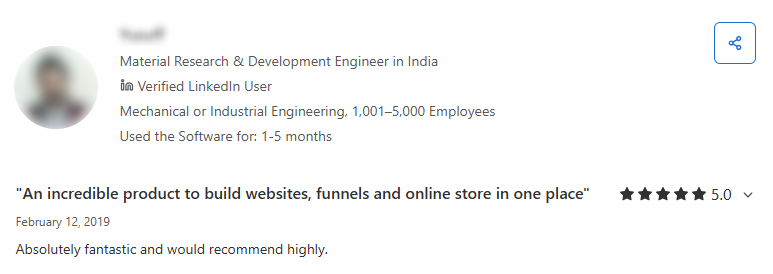
Where Users Struggle: Cons
Complex issues take more resolution time. Support does respond quickly, but some reviewers have said that difficult problems can take a week or more to fix. A fast response doesn’t always mean a fast solution.
Coming to the templates, some users report that elements don’t line up properly and have inconsistent spacing between the widgets. Now, these are minor issues for most websites, but they can matter more for the clients who need impactful and precise designs.
This is one of the verified reviews of founders on Findstack:
What do you dislike about Simvoly?
Some small style things in the templates, like things being slightly out of alignment. Spacing between widgets seems to shift unaccountably.
Some users find mobile adjustments and custom code more limited than WordPress. This is a common trade-off with closed website builders, and may not be suitable for users who need greater design control.
The video hosting options and advanced built-in commenting features can be better.
Some users find membership features difficult to use, while others see them as a strength. Since these reviews are mixed and some are older, test these features during the free trial if courses are important to your business.
Some users say the free academy and video tutorials helped them get started within days. Others report outdated tutorials and a confusing dashboard. Plan to spend some time learning the platform instead of relying entirely on its tutorials.
Plan limits (documented, not a complaint):
These are published limits you can check on Simvoly’s pricing page rather than user opinions. Every plan has traffic limits, from 20GB on Starter to 200GB on Elite, and plans below Elite allow only one website. Funnels are excluded from Starter and capped at 5 on Business and 10 on Premium.
These are documented limits, but they can become a problem as your business grows.
Agency Fit
Where Simvoly makes sense
When you want recurring platform revenue instead of one-off project work.
When your clients need sites, funnels, email and simple ecommerce, but do not require custom development.
You want the software to run under your own brand, domain, and pricing. You don’t have in-house technical depth, because Support is the platform’s most consistently praised feature.
The economics
- White-label plans cost $59, $129, or $429 per month when paid yearly.
- You also pay a fee for each client project. It costs $8, $7, or $5 per project, depending on your plan.
- You choose what to charge your clients. The difference between your price and your costs is your margin.
- Costs increase as you add more clients. For example, 50 clients means roughly 50 times the per-project cost of one client. Calculate your costs based on how many clients you plan to have, not just on how many you have at present.
Where to compare alternatives
Operating model:
If you mainly sell services and don’t want to become a software company, white-labeling can create extra work. You may have to handle billing, customer support, and clients leaving the platform.
Client scale:
If you have many clients already, a platform with unlimited client accounts for one fixed price may cost less than paying for every client.
Automation needs:
If you are in need of advanced automation, complex rules, or a full sales CRM, Simvoly may not have everything that you require.
Product needs:
If your clients need custom features, advanced integrations, or custom development, WordPress or a custom-built solution may be a better fit.
If you’re also considering a newer option like Centripe, here’s how it compares with Simvoly across the areas that matter most to agencies.
Centripe Comparison
Simvoly vs Centripe: How They Compare for Agencies
| Criteria | Simvoly | Centripe |
|---|---|---|
| Pricing model | Platform fee plus a fee per client project | Flat monthly fee, no per-user or per-contact charges |
| Entry price | $59/month plus $8 per project | $99/month |
| Cost as you scale | Rises with each client added | Fixed, with 3 sub-accounts on Essentials and unlimited on the $299 plan |
| White label | On all three WL tiers | On both plans, with SaaS resale on the $299 plan |
| CRM depth | Leads, forms, orders and customers | Contacts, deals, pipelines and tasks |
| Automation | Email flows, SMS, WhatsApp, voice | Workflow automation, AI chatbots, voice AI |
| Ecommerce | Full storefront, 0% transaction fees | Funnels, checkout, courses |
| Best fit | Selling websites and funnels under your brand | Selling a full operating platform under your brand |
Frequently Asked Questions