
Every business has people who hear about it and people who actually buy from them. The gap between those two groups? That’s where most businesses lose money without even knowing it.
A sales funnel is the map of that gap. It shows you exactly where people are coming from, where they’re dropping off, and what it takes to turn a stranger into a paying customer. Without it, you’re guessing. And guessing is expensive.
This guide tells you what a sales funnel is. It explains how each stage works. You’ll see real examples and get step-by-step instructions to build one.
What is Sales Funnel?
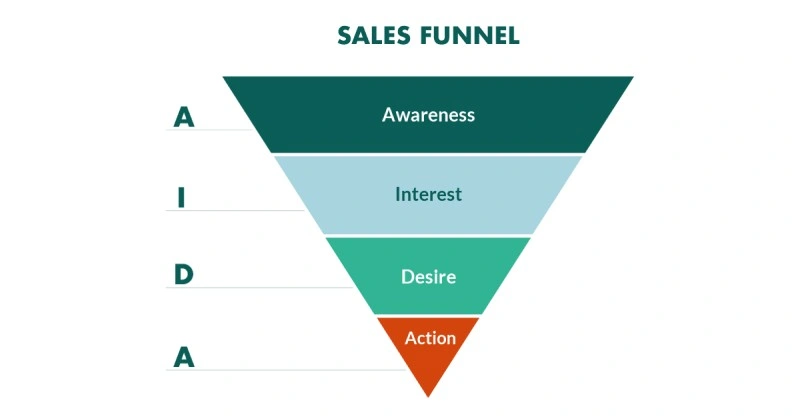
You put so many people in business (so-called leads or prospects). Some of them buy, and most don’t. A sales funnel will make you realize how and why you can continue to get more people moving down to the bottom.
The “funnel” shape matters here. Wide at the top because lots of people hear about you. Narrow at the bottom because fewer actually purchase. Your job is to make it as un-narrow as possible.
Each funnel has levels, and the name of the levels varies depending on the person you question. But the idea is the same: awareness, interest, decision, action.
Why Does a Sales Funnel Matter?
Here’s the honest truth: without a funnel, you don’t actually know what’s working. A sales funnel analysis shows where potential customers are leaving and which stages need help.
You might be spending money on ads that bring in the wrong people. You might be sending emails nobody reads. You might be losing customers right before they pull out their wallet, and you’d have no idea.
A sales funnel gives you a system. You can look at each stage and ask: “Are people moving forward here? If not, why?” That question alone is worth thousands of rupees (or dollars) saved.
It also helps your sales and marketing teams work together. Marketing brings people in. Sales close them. A funnel shows where one stops and the other starts.
Sales Funnel vs. Marketing Funnel: What’s the Difference?
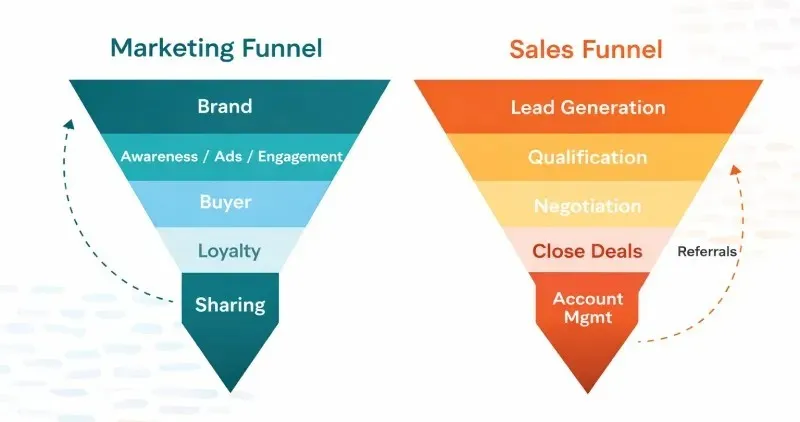
People mix these up all the time, so let’s clear it up fast.
The first is the marketing funnel. It is about making people understand that your brand has been born. Think ads, posts on social media, blog posts, and YouTube videos. It is aimed at creating awareness.
Sales funnel resumes after that. When a person becomes familiar with you and displays some genuine interest, he or she enters the sales funnel. And the objective is now: convert that interest into a purchase.
Here’s the line between them: a Marketing Qualified Lead (MQL) is someone who clicked your ad or read your blog. They’re interested, but casually. A Sales Qualified Lead (SQL) is someone who filled out a form, asked for a demo, or said, “I want to buy.” They’re ready to talk money.
The time of your sales team would be better used on SQLs. The task of your marketing team is to produce as many MQLs as possible and warm them up.
Sales Funnel Examples
Example 1: A Clothing Store Online
- Awareness: Priya scrolls through Instagram and sees a reel of someone styling a kurta she loves. She clicks on the page.
- Interest: She goes to the site and scrolls for 10 minutes, and then decides to sign up for the first order 15% off deal.
- Decision: Over the next few days, she gets emails showing the kurta in different colors, a size guide, and some customer photos. She’s almost convinced. Within a few days, she receives emails with images of kurtas in other colour options, a size guide, and a few pictures of customers for testimony. She’s almost convinced.
- Action: She uses the discount code. Order placed.
Bonus move: After purchase, she gets a pop-up: “Add a matching dupatta for just ₹299 more.” She adds it. Sale increases without any extra ad spend.
Example 2: A SaaS Sales Funnel
- Awareness: Rahul learns “ how to manage team tasks without mess.” He finds a blog post from a project management tool.
- Interest: The post is helpful. He navigates through the site and subscribes to a 14-day free trial.
- Decision: During the trial, in court, he receives onboarding emails, a 5-minute tutorial video, and a case study that a similar company was able to save 6 hours a week with the help of the tool.
- Action: On day 12, he receives an email: “Your trial ends in 2 days. Lock in the beginner plan for ₹499/month.” He subscribes.
The Real Benefits of Having a Sales Funnel
1. You Stop Flying Blind
Without a funnel, you’re looking at your total revenue and hoping things improve. With a funnel, you can see: “Okay, 500 people visited the product page, but only 20 added to cart. Something’s wrong on that page.” That’s actionable.
2. You Close More Deals Without Working Harder
A funnel lets you send the right message at the right time. Someone who just heard about you doesn’t need a “Buy Now” push. They need education. Someone who already compared you to competitors? They need a reason to choose you today. Matching the message to the moment is what converts.
3. You Stop Wasting Budget
When you know which stage is leaking, you fix that stage, not everything at once. You don’t throw money at more ads if the problem is that people drop off during checkout. You fix checkout first.
4. You Build Trust Before You Ask for Money
A good funnel warms people up slowly. You give value first (blog posts, free guides, trial periods), and then ask for the sale. That’s a much easier conversation than cold-calling someone and asking them to buy on the spot.
5. It Scales With You
Build the funnel once, set up some automation, and it works even while you sleep. Email sequences go out automatically. Retargeting ads run on their own. You’re nurturing 1,000 leads at once without a 1,000-person team.
To create an automated sales funnel, first connect lead capture with follow-up emails. Then, automate other repetitive tasks.
How to Create a Sales Funnel: Step by Step
Step 1: Know Exactly Who You’re Talking To
Having a clear understanding of your customer before you create anything. Not “ everyone who might be interested”. What’s their biggest problem? What have they already tried? What would that make them believe you?
The less general the better, the more your message sounds as though you are speaking to them directly, and it is this that makes people pay attention.
Step 2: Create Awareness
Put oneself in front of the right people. This could be:
- Running ads on Instagram, Google, or YouTube
- Writing SEO blog posts, which are researched by people
- The sharing of useful material on LinkedIn or Twitter
- Collaborating with somebody who already has the trust of your audience.
The goal at this stage isn’t to sell. It is to make people curious enough to take a closer look.
Step 3: Give Them a Reason to Stay (Lead Magnet)
The majority will not purchase when they first hear about you. So offer them something worthy in order to get their email or contacts. A free guide, discount, free consultation, or maybe a tool they can use right now.
This is called a lead magnet. It moves them from “random visitor” to “someone you can follow up with.”
Step 4: Nurture with Value
Now that you have them on your side, do not sell right away. Provide them with useful material: tips, case studies, how-to, and answers to the most frequently asked questions. Build familiarity. Consumers purchase products and brands that they trust.
It may take two days or two weeks, or whatever you are selling. A ₹199 product will not require as much nurture as a ₹1,99, 000 service.
Step 5: Make the Offer
When they have viewed your worth, then make an open, direct offer. Inform them on what they are getting, its price, and why it is the time to do it. Don’t be vague. Click here to get started is less impressive than Join 3,000 small businesses using our tool, starting at 499/month.
Add urgency (real constraints, an actual sale with a time constraint, a bonus based on time). Individuals are aware when it is fake, and it destroys trust.
Step 6: Close and Onboard Well
The sale isn’t the finish line. The first few days after purchase are the ones that will determine whether they remain, refer friends, or request a refund. Send a great welcome message. Make them think that they did a correct decision.
Step 7: Track, Test, Improve
To improve sales funnel performance, check your numbers each week and find where prospects are dropping off ? A different subject line. A new landing page headline. A shorter checkout form. Minor repairs have long-term outcomes.
Common Mistakes That Kill Funnels
- Trying to sell too fast: People need time to trust you. Rushing kills deals.
- Building for everyone: A funnel that speaks to everyone speaks to no one. Niche down.
- Neglecting the bottom of the funnel: The majority of businesses are obsessive regarding awareness (getting traffic) and never take any action to correct the fact that people are not buying after they are ready to buy.
- No follow-up: Most people need 5-7 touchpoints before buying. One email isn’t enough.
No Spam. No calls. Unsubscribe anytime.
Conclusion
A sales funnel is not a complicated marketing tool. It is simply an overview of how individuals change from hearing about you to paying you.
Build it with intention. Know who you’re targeting. Warm them up. Make a good offer. Follow up. And continue to get better using real numbers, and not gut feelings.
It is the way you can transform a business that is spilling and vague at times, into a business that expands even when you are not actively selling.
Frequently Asked Questions